Naturally Texas: What Makes Land a Home
The next phase of the Reigniting Curiosity renovation will expand how visitors explore the dynamic relationships that shape the natural world. Naturally Texas: What Makes a Land Home will transform the Mayborn Museum’s ecology gallery into an immersive exploration of the natural systems that shape our region. Visitors will step into richly detailed environments—from neighborhood landscapes alive with hidden connections to the darkened depths of caves where bats emerge at dusk.
Give today
Your support will bring this vision to life—expanding access to the museum’s collections, advancing scientific discovery, and inspiring future generations to care for the place we all call home.
Naturally Texas: What Makes a Land Home
The exhibition is organized into a series of immersive “clusters,” each centered on a key ecological relationship or function. Within each space, a signature experience anchors the story—surrounded by interactive elements, specimens, and layered interpretation that deepen understanding. As visitors move through the gallery, recurring themes such as biodiversity, stewardship, and the role humans play in shaping the environment connect these clusters into a cohesive journey. Along the way, moments of surprise and discovery invite visitors to reconsider what they think they know about the natural world right here in Central Texas.
Naturally Texas Clusters
Nothing in an ecosystem exists alone. The health of one species can affect an entire community of plants, animals, and other organisms. “Rising from the Ashes” explores the Ashe juniper tree and the many organisms and ecosystems connected to it. Visitors will discover how one species can provide food, shelter, and other resources that support an entire community of life. Visitors will explore the relationships between the Ashe juniper and the organisms that depend on it, including the golden-cheeked warbler. Scientific specimens from the Mayborn’s collections will help illustrate these ecological connections. Visitors will learn that ecosystems are interconnected and that individual species can play important roles in supporting biodiversity.
Understanding the relationships between species helps visitors see Central Texas as an interconnected ecosystem rather than a collection of individual plants and animals. That understanding is an important first step toward stewardship. Objects from the Mayborn Museum’s natural history collections will illustrate the organisms and ecological relationships found in Central Texas.
What secondary experiences are included?
A two-sided collections wall will feature some of the Mayborn’s most exciting specimens, giving visitors an opportunity to explore the scientific value of museum collections.
Healthy ecosystems are built from relationships. Even small actions, such as planting the right plants at home, can support the larger ecosystem. “Stories of Growth” explores what it takes to maintain a healthy Central Texas ecosystem. Visitors will discover how plants, pollinators, soil, wildlife, livestock, and other organisms work together to create a healthy landscape. Visitors will arrange story blocks representing different components of an ecosystem. When the blocks are arranged in the right combination, oversized projections of Central Texas organisms appear, bringing the ecosystem to life. Visitors will learn about the roles of plants, pollinators, soil disruptors, nutrient cyclers, wildlife, and livestock in maintaining a healthy ecosystem. Healthy ecosystems depend on many interconnected relationships. Understanding those relationships can help visitors recognize how their own yards, gardens, and communities can contribute to biodiversity. Projected organisms may include a butterfly swooping in to feed on a massive flower, leafcutter ants carrying food underground, or a pocket gopher emerging from the soil.
What secondary experiences are included?
Make a Garden Fit for a Monarch
Visitors will learn about the monarch butterfly migration route through Texas and explore how to plan a monarch waystation garden at home.
Meet a Conservationist
Visitors can meet a conservationist from Burleson Prairie and learn how they work to maintain and protect this special Central Texas landscape.
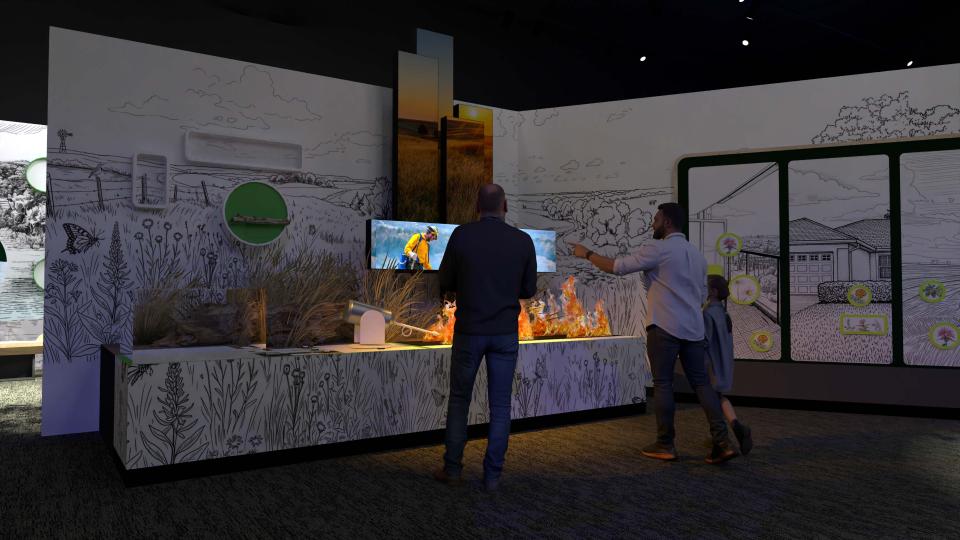
When used safely and intentionally, prescribed fire can help restore and maintain healthy landscapes. “Fire Safety” explores the important role fire plays in healthy, biodiverse prairies. Visitors will learn how conservationists use carefully planned prescribed burns to manage ecosystems and support native species. Visitors will take on the role of a burn manager. They will work through the planning and safety steps required before a prescribed burn and then use a drip torch to initiate a simulated burn across a prairie landscape. Visitors will learn the difference between a carefully planned prescribed burn and an uncontrolled wildfire. They will also discover how fire can support native species, increase biodiversity, and promote healthy ecological succession. Fire is a natural and necessary part of many Central Texas ecosystems.
What secondary experiences are included?
Meet a Burn Manager
Visitors can meet a conservation manager from Rocosa Ridge Ranch in Bosque County and learn how controlled burns are used on a working ranch to restore native ecosystems.
What is the big takeaway?
Fire isn't always the enemy. In the right place, at the right time, and under the right conditions, fire can be an important tool for maintaining healthy ecosystems.
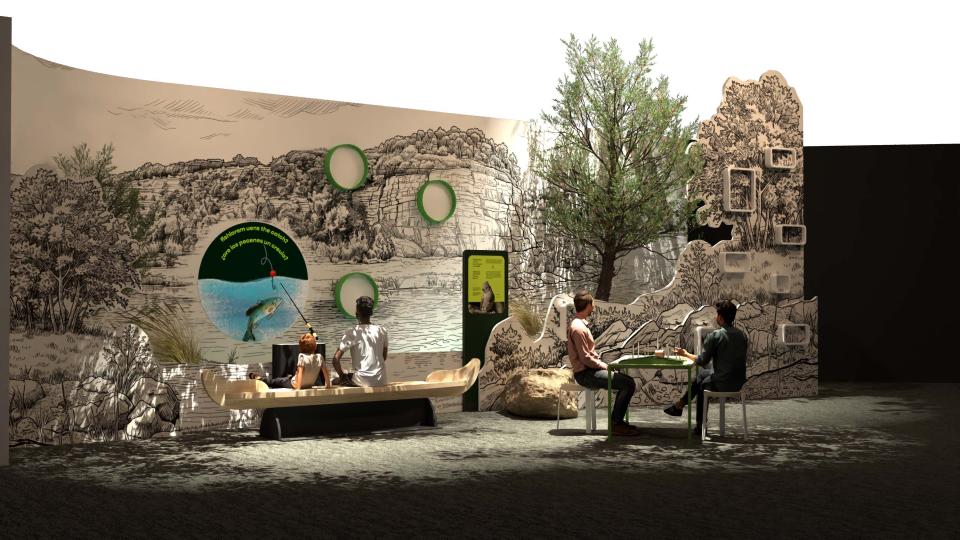
Healthy rivers support healthy communities. What we do at home and in our communities can affect the water systems around us. Clean, plentiful water is essential for people, wildlife, and the entire Central Texas ecosystem. Understanding the health of our waterways helps visitors recognize their role in protecting them. “Angling for a Healthy River” connects an everyday outdoor activity—fishing—to the health of Central Texas rivers and waterways. Visitors will use a tactile fishing rod to catch organisms beneath the surface of a simulated river. Each catch provides clues about the health of the river ecosystem. Visitors will compare a healthy riparian system with a struggling one and learn how organisms can serve as indicators of water and ecosystem health.
What secondary experiences are included?
Meet a CRASR Center Researcher
Visitors can meet a researcher from Baylor University’s Center for Reservoir and Aquatic Systems Research (CRASR) and learn about efforts to keep water clean and plentiful throughout the Brazos River basin and Central Texas.
Choose Water
Visitors will explore how everyday household choices affect water resources and discover simple ways to reduce their water use.
Bats are essential members of our ecosystems. Protecting bats and their habitats helps support healthy environments for people and wildlife. “A Storm of Bats” gives visitors an up-close look at one of Central Texas’s most spectacular natural events: a bat emergence. Visitors will experience millions of projected bats swarming overhead as they leave a cave for their nightly flight. After the emergence, visitors can peer into a simulated cave and see the thousands of pups living inside a maternity colony. Visitors will learn about bat behavior, maternity colonies, and the important role bats play in Central Texas ecosystems. Central Texas is home to some of the most significant bat populations in the world. Bats provide important ecosystem services, including helping control agricultural pests. The experience is inspired by caves in and around Central Texas, including Bracken Cave and Friesenhahn Cave.
What secondary experiences are included?
Meet a Researcher from Bat Conservation International
Visitors can learn about the threats facing bats and the conservation efforts underway to protect them.
Homes and Gardens
Visitors will discover how planting a night garden can support local bat populations by attracting nocturnal insects and the plants those insects depend on.
How to Make a Cave in 20 Million Years
Visitors will explore the geology beneath Texas and learn how four different types of caves form over millions of years.
Predators are an important part of healthy ecosystems. By understanding wildlife and making thoughtful choices, people can help create space for both humans and wild animals to thrive. "A Little Cache Goes a Long Way” explores the predators of Central Texas, with a focus on the region’s big cats, including ocelots, jaguars, mountain lions, and bobcats. Visitors will investigate a simulated prey cache and use clues such as scents, tracks, and other traces to determine which predator made the kill. Visitors will learn how scientists and wildlife professionals use physical evidence to understand animal behavior and identify predators. Large predators play important roles in ecosystems, but many of Texas’s big cats have become increasingly rare. Understanding these animals and their relationships with people is an important part of conservation.
What secondary experiences are included?
Meet a Wildlife Control Officer and Ocelot Reintroduction Worker
Visitors can learn how wildlife professionals help cougars and bobcats safely coexist with people and livestock and how conservationists are working to reintroduce ocelots to Texas.
Your Ferocious Pal
Visitors will discover the surprising predator living in millions of American homes: the domestic cat. This experience explores the impact free-roaming cats can have on songbirds and other wildlife and provides ways people can reduce that impact.
An Ice Age Collection
Visitors will travel back thousands of years to explore the animals that once lived in Central Texas. Specimens from Friesenhahn Cave—including saber-toothed cats, mammoths, turtles, and other Ice Age animals—provide a window into how Central Texas ecosystems have changed over time.
The Strecker Collection
At the heart of the exhibition is the Mayborn’s extraordinary Strecker Collection. Spanning more than a century of scientific collecting, these specimens document the biodiversity of Texas across time. They are not only beautiful—they are data. By studying them, scientists can track environmental change, understand species variation, and uncover insights that help guide conservation and research today.
“Whenever I go on a collecting jaunt, I always make it a point, not matter how roughly attired I may be, to wear a collar and a necktie. With this mild form of camouflage I sometimes manage to get by on occasions when the lack of it might severely handicap me (in gaining access to private property).”
Give Today
Every corner of this exhibition is filled with discovery—ecological relationships, hidden systems that sustain life, and the remarkable organisms that call Central Texas home. Yet one idea rises above all others: we are not separate from the natural world—we are part of it.
We breathe the air shaped by prairie grasses. We rely on water filtered through living systems. The soil sustains us, just as we influence its future. Every step we take is part of a continuum of life that stretches across generations—past, present, and future.
This exhibition invites visitors to see the natural world not as something distant, but as something deeply personal. The landscapes of Central Texas—the plains, rivers, and forests—are not just places we visit. They are systems we belong to, and communities we share with countless other forms of life.
With that connection comes responsibility. To care for this place is to care for ourselves, for future generations, and for the intricate web of life that makes this region so extraordinary.
Thank you to the donors who have already contributed to this project:
Institute of Museum and Library Services
H-E-B Tournament of Champions
Cooper Foundation
Leo and Paulette Brown
Mazanec
Anthony and Donna Robert
William Dube